


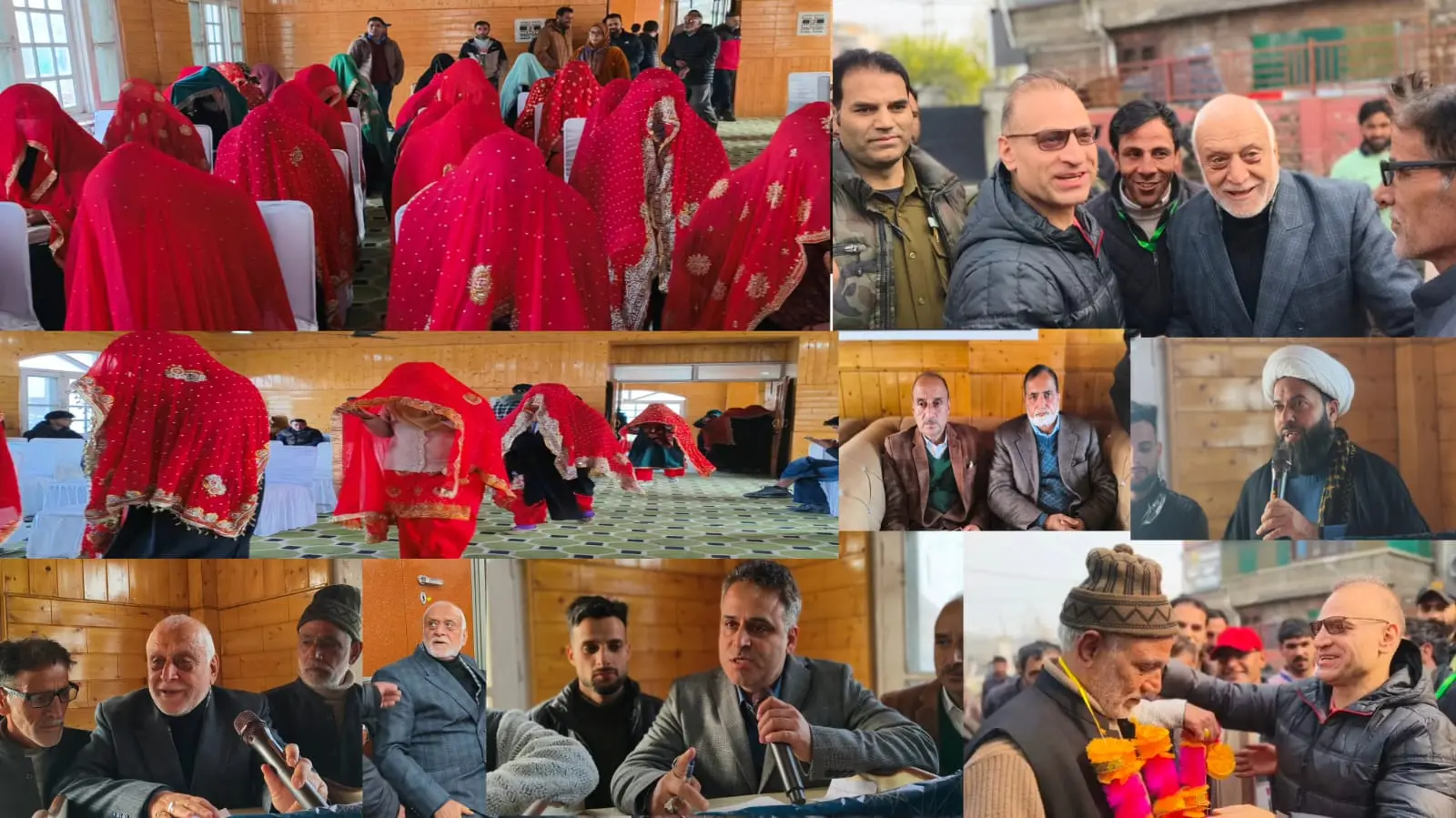
DIG Imtiyaz Hussain Appreciates Jaffari Council’s Initiative to Promote Simple Marriages
Srinagar, November 22:* In a significant initiative aimed at promoting simple marriages, discouraging the dowry system and extending support to economically weaker sections of society, 32 couples from different parts of Kashmir tied the knot at the 12th Ijtimai Shadi (Joint Marriage Ceremony) organised by the Jaffari Council of Jammu and Kashmir at Marriage Hall Baba Demb, Barbar Shah, Srinagar, on Sunday.
The annual mass marriage ceremony was organised by the Jaffari Council of Jammu and Kashmir in collaboration with J.U. Kulsum Taleem Kendra, Bhavnagar, Gujarat, India. The programme was held under the leadership of Council Chairman Haji Musadiq Hussain Manhas, reflecting the organisation’s continued commitment to supporting underprivileged families and promoting simple and dignified marriages.
The ceremony witnessed the participation of prominent Islamic scholars, religious personalities, social activists, community representatives, well-wishers and people from different walks of life. Deputy Inspector General of Police (DIG) Imtiyaz Hussain was also present on the occasion and appreciated the initiative aimed at promoting social welfare and supporting deserving families.
The Jaffari Council, a religious and social welfare organisation, has been organising annual mass marriage ceremonies to assist orphaned girls, underprivileged women and economically weaker families. Through its Ijtimai Shadi initiative, the organisation seeks to ensure that financial difficulties do not become an obstacle for deserving couples wishing to begin their married lives with dignity and happiness.
Addressing the gathering and speaking to media persons, Chairman Haji Musadiq Hussain Manhas said that the basic objective of organising mass marriage ceremonies was to promote simple Nikah and provide meaningful assistance to families struggling with the increasing expenses associated with weddings.
He said marriage is a sacred social institution and should not become a financial burden on parents, particularly those belonging to economically weaker sections. Every deserving boy and girl, he said, should get an opportunity to begin a new chapter of life with dignity, respect and happiness, irrespective of their financial background.
Manhas expressed concern over the growing influence of the dowry system and extravagant wedding celebrations, saying that such practices have placed unnecessary financial pressure on ordinary families, especially parents of daughters.
He appealed to people to reject dowry in all its forms and adopt simple marriage practices in accordance with religious and moral values.
” Nikah should be simple and affordable. Marriage is not about showing wealth or arranging expensive celebrations; it is about mutual understanding, responsibility, respect and commitment between two individuals and their families,” he said.
He further said that the council’s mission goes beyond organising mass marriages, as it also aims to create awareness about social issues and encourage collective efforts to bring positive changes in society.
The chairman appreciated the contribution of donors, volunteers, religious personalities and well-wishers who extended their support to make the 12th edition of the programme successful. He said collective participation from society could help deserving families overcome financial challenges and ensure that no couple is deprived of marriage because of poverty.
Speaking on the occasion, General Gh. Rasool Chakana also highlighted the importance of simple Nikah and said unnecessary wedding expenditure and social pressure had made marriages increasingly difficult for economically weaker families.
He said people must return to the basic values of simplicity, brotherhood and mutual cooperation. Appealing to parents and community members, Chakana said expensive weddings should not be considered a matter of social prestige, as a dignified marriage does not require lavish arrangements or unnecessary financial expenditure.
He appreciated the Jaffari Council for taking an initiative that provides practical assistance to deserving families while spreading awareness against dowry and extravagance. He added that simple Nikah should be encouraged so that young people can begin their married lives without the burden of loans, financial difficulties or unreasonable social expectations.
Other speakers, including Islamic scholars and community representatives, also appreciated the efforts of the Jaffari Council and stressed the need to revive the tradition of simple Nikah in society.
The speakers said that Islam encourages simplicity in marriage and that unnecessary expenditure, dowry demands and extravagant celebrations should be discouraged. They urged parents, religious leaders, youth and social organisations to work collectively towards eliminating harmful social practices and promoting marriages based on religious values, mutual understanding and respect rather than financial status or social display.
Tehsil President of Khag, Ab Rashid Khan, also appreciated the initiative and said that mass marriage programmes provide much-needed relief to families who cannot afford the high expenses associated with traditional wedding ceremonies.
He said the dowry system and unnecessary wedding expenditure had emerged as serious social challenges, particularly for poor parents. He stressed the need for greater awareness among communities and urged people to support initiatives promoting equality, simplicity and social responsibility.
Ab Rashid Khan further said that society must collectively work towards ending harmful customs and ensuring that financial status does not determine a person’s opportunity to get married. He appreciated the Jaffari Council leadership for extending support to deserving couples and setting an example for other social and religious organisations.
As part of its welfare initiative, the council also provides essential household items to newlywed couples, including bedding, utensils, clothing and basic household appliances, helping them establish their homes and begin their married lives with greater comfort.
Speaking on the occasion, DIG Imtiyaz Hussain appreciated the social welfare initiatives of the Jaffari Council and described its efforts to promote simple marriages and support economically weaker families as commendable and worthy of emulation.
He said that the council’s commitment to helping deserving families was an excellent example of social service. Such initiatives not only provide much-needed support to poor and needy families but also strengthen the values of brotherhood, equality and mutual cooperation in society.
The DIG congratulated the council’s leadership and all organisers for successfully conducting the welfare programme and expressed hope that such positive initiatives would continue in the future, inspiring other social and religious organisations to come forward and undertake similar activities.
At the conclusion of the programme, Fida Hussain presented the vote of thanks, expressing gratitude to the distinguished guests, Islamic scholars, religious personalities, Chairman Haji Musadiq Hussain Manhas, representatives of the collaborating organisation, donors, volunteers and all those who contributed to the successful organisation of the ceremony.
He appreciated the collective efforts of everyone associated with the initiative and said continued public support was essential to carry forward such welfare activities for the benefit of underprivileged families.
The 12th Ijtimai Shadi concluded with a strong message of simplicity, social equality, mutual cooperation and collective responsibility. The organisers expressed hope that such initiatives would inspire more organisations, religious institutions and individuals to come forward in support of economically weaker families.
The programme once again highlighted the importance of simple Nikah, discouraging dowry and ensuring that marriage remains a source of happiness rather than a financial burden on families. The successful solemnisation of marriages of 32 couples marked another significant step towards promoting a more compassionate, supportive and socially responsible community.

